
What Another Season of Waiting Actually Costs
Skip garage door prep one more season and you're not just risking a dent or a jammed track. You're risking the whole house. When a garage door fails in high wind, the pressure that was supposed to stay outside rushes in, pushes up against the roof decking from underneath, and can peel a roof off a structure that would have otherwise ridden out the storm just fine. Insurance adjusters see this pattern constantly after tropical systems: roof damage that traces back to a garage door that blew in first. Fixing a weak door before the season ends costs a fraction of what a roof replacement runs, and it takes a fraction of the time.
Why the Garage Door Is the Weakest Wall
Every other opening in a home — windows, entry doors — is small and reinforced by a solid frame on all four sides. A garage door is the largest moving opening in most houses, often 16 feet wide or more, built from panels that flex, riding in tracks that were never designed to resist a sustained sideways push. When wind hits the front of a house, the garage door takes the brunt of it. If it buckles, bows, or blows off its tracks, the building suddenly has an open hole where a wall used to be, and internal pressure does the rest of the damage.
This is why wind-load-rated doors and reinforcement kits exist. A door rated for wind load has heavier gauge steel, reinforced struts across the back of each panel, and a stronger track and roller system designed to keep the door in place when it's pushed from outside. If your door was installed years ago or came with a house as a builder-grade unit, there's a decent chance it was never upgraded to current wind-load standards.
How This Stretch of Florida Weather Works Against You
Late-season tropical systems still move through North Florida well into November, and they arrive on top of a summer's worth of wear that's already weakened the hardware:
- Salt air corrosion. Coastal humidity and salt accelerate rust on springs, hinges, and track bolts. Corroded hardware fails at lower wind speeds than hardware in good condition.
- Humidity swelling. Wood-trimmed doors and wood jambs swell in the heat and moisture, which can throw off the seal and the fit of the door in its frame, leaving gaps that wind can get a grip on.
- Afternoon downpours. Repeated soak-and-dry cycles loosen fasteners and promote rust at the exact spots — hinges, track brackets, roller stems — that need to hold firm under pressure.
None of this shows up as a dramatic failure on a calm day. It shows up as a door that's already compromised the moment a storm puts real load on it.
A Practical Storm-Readiness Checklist
Inspect the Hardware
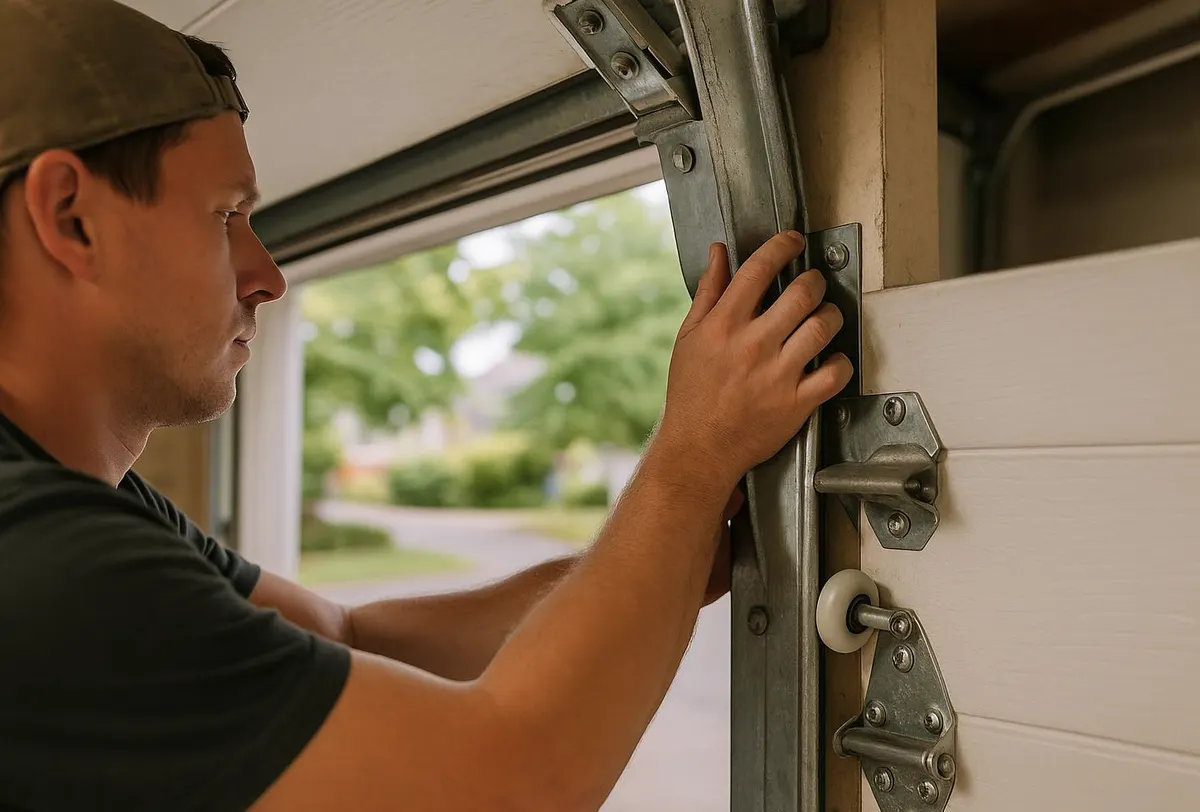
- Check every hinge, roller, and track bracket for rust or looseness. A bracket with pulled-out screws will not hold under wind pressure no matter how strong the door panel is.
- Look at the bottom bracket area carefully — this is a high-tension spot and one of the most common failure points.
- Test the springs. A spring that's sagging, stretched, or visibly corroded should be replaced before storm season, not during it.
Confirm Wind Resistance
- Find out if your door has reinforcement struts across the back of the panels. If it doesn't, a retrofit kit can often be added without replacing the whole door.
- If the door is original to an older home, ask whether it meets current wind-load expectations for this area. Many older doors predate stricter wind-load standards entirely.
Check the Track and Rollers
- Tracks should be firmly bolted to the framing with no visible flex when the door moves.
- Rollers that are cracked, worn, or jumping the track under normal operation will fail faster under wind load.
Don't Forget the Opener
- A battery backup on the opener means the door can still be operated manually or electrically during a power outage, which matters if you need to reposition or secure the door quickly.
- Know where the manual release cord is and confirm it works, in case the door needs to be operated by hand.
After the Storm Passes
- Walk the track and panels for new dents, bent sections, or water intrusion at the bottom seal.
- Listen for new noises on the next few openings — grinding, popping, or scraping often means something shifted during high wind even if the door still looks fine.
When to Call Precision Garage Door of Ponte Vedra Beach
If an inspection turns up corroded hardware, a door with no wind reinforcement, or springs that look questionable, it's worth getting a professional opinion before the next system is on the radar. Precision Garage Door of Ponte Vedra Beach handles Preventive Maintenance visits that check every point of failure listed above — hinges, rollers, track alignment, spring tension — and catch the small issues before they become storm failures. If your door needs reinforcement or replacement hardware to meet current wind-load expectations, our Garage Door Installation team can walk you through options that fit your home and your budget, from retrofit strut kits to full wind-load-rated door replacements.
Don't wait for a forecast to find out your garage door is the weak point in your home. Call Precision Garage Door of Ponte Vedra Beach today and get your door storm-ready before the next system develops.